Replying to chat: the path from one text box to three platforms
7cubit Team
More in Engineering
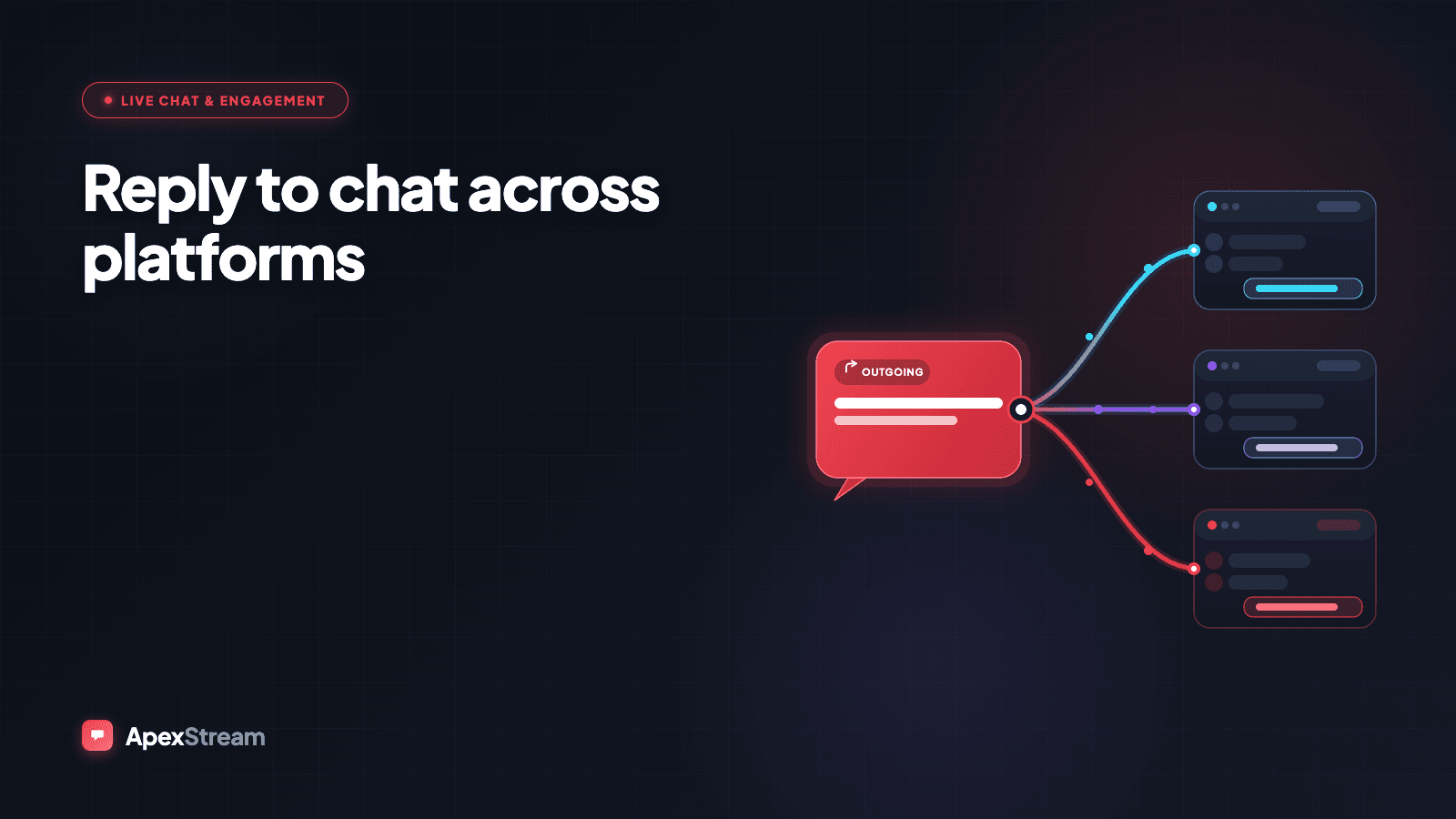
Typing one reply in Web Studio feels like one action. Delivering it involves three different systems: YouTube needs a live chat ID, Facebook needs the live Page context and token, and Twitch expects an IRC message. The send result therefore has to describe partial success instead of pretending every platform behaves the same.
Which destinations can receive a reply?
The outbound chat path considers YouTube, Facebook, and Twitch targets on the live station. Custom RTMP, SRT, LinkedIn, TikTok, and other video-only destinations may be valid stream outputs but do not appear in the reply results.
If a station has no chat-capable target, the request can return success with zero deliveries. The video can still be live; there simply was no supported chat API to call.
YouTube: send to the live chat, not the channel
A YouTube channel ID is not the same object as the live chat ID required to post a message. The send path loads the customer's YouTube integration, resolves the active broadcast's liveChatId through the same cached service used by polling, and sends through the live chat API.
If more than one YouTube integration is available, the service can try another when one token or target fails. One expired connection should not prevent a separate live channel from receiving the reply.
Facebook: use the Page identity for a Page stream
Facebook replies use a Page access token and the live video context created when the broadcast started. A Page destination needs the Page's permissions; sending as a personal profile would be the wrong identity for that target. Profiles and Pages are supported destination types; Groups are not.
The live-session record used by the chat poller provides the object context for the send. That keeps inbound comments and outbound replies pointed at the same live post.
Twitch: IRC says the message
Twitch chat is handled through the IRC client already maintained for the live session. The host message is sent with the authenticated channel connection. If that client never connected or has left the channel, Twitch returns a failed result without stopping the YouTube and Facebook attempts.
What “sent” means
The result is intentionally useful for a host who needs to keep talking. You can acknowledge a successful delivery and still see which platform needs repair. That is better than blocking the live conversation on the slowest or least recently re-authenticated integration.
The service collects a result for each platform attempt, such as { platform, ok }. The delivered count is the number of successful attempts, and the top-level success value is true when delivered > 0.
This avoids a common duplicate problem. If YouTube accepts the reply and Twitch rejects it, reporting a total failure may prompt the host to send the same line again and duplicate it on YouTube. The per-platform results show the failure while the summary tells you at least one audience received the message.
The path in one view
Host text
  → authorize the customer and load the live session
  → keep YouTube, Facebook, and Twitch targets
  → resolve YouTube liveChatId and send
  → resolve Facebook Page token and live context and send
  → send through the Twitch IRC client
  → return success, delivered, and per-platform results
Custom RTMP and LinkedIn are not missing from the response by accident. They are video destinations outside the three outbound chat integrations.
Why the partial result is the useful result
Creators think “my chat,” while each platform uses its own authorization and live identity. A unified text box is a translation layer. Showing partial delivery lets the host repair the false rows—reconnect Facebook or re-authorize YouTube—without claiming that nothing worked.
Success means at least one supported platform accepted the message. The detailed results tell you which one.
That definition keeps one expired token from blocking the rest of the room and keeps a successful reply from being duplicated during troubleshooting.
For the creator, the practical habit is to read the platform results after a send when the room is busy. If one row is false, repair that integration after the segment rather than repeating the message to every destination immediately.
The message box stays unified; the result remains specific. That is the balance that lets a host reply quickly without losing track of where the line actually landed.
Read the send result this way
- YouTube replies use the active live chat, not only the channel ID.
- Facebook replies use the Page identity and the live video context.
- Twitch replies use the authenticated IRC channel connection.
- A partial success is still useful: repair only the platform whose result is false.
One message, three delivery systems
| Platform | Identity used | If it fails |
|---|---|---|
| YouTube | The active live chat ID | Re-authorize or check the active broadcast |
| The Page token and live video context | Reconnect the Page integration | |
| Twitch | The authenticated IRC channel | Check that the chat client is connected |